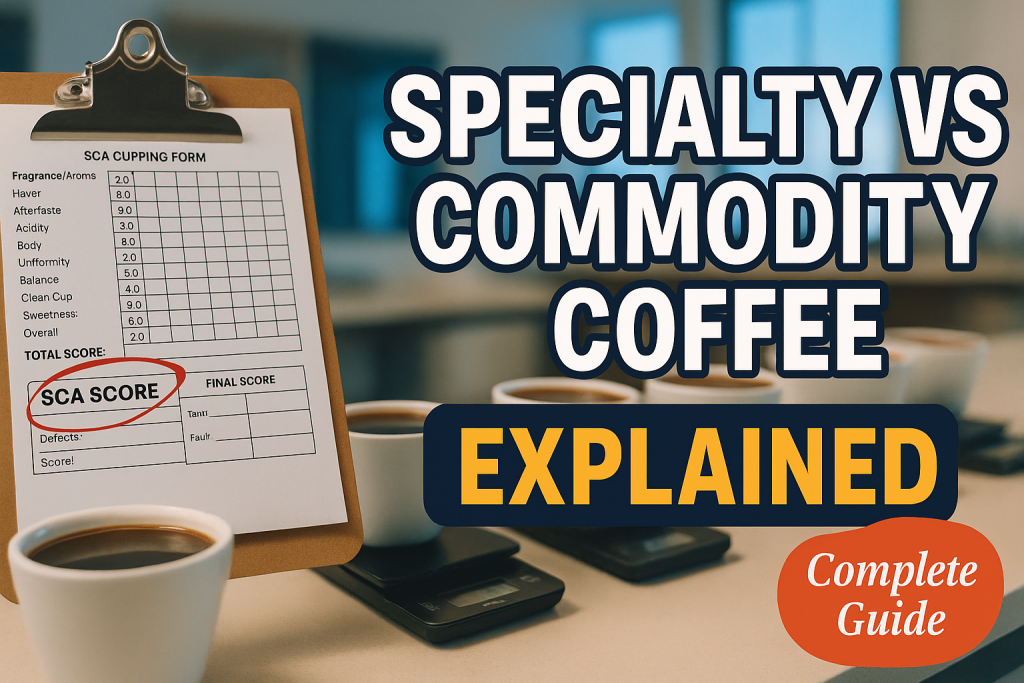
Specialty vs commodity coffee defined Commodity coffee is standardised, exchange-traded coffee priced off the ICE Coffee “C” contract (arabica) or LIFFE Robusta contract, with minimum quality specifications allowing broad origin blending. Specialty coffee scores 80 or above on the Specialty Coffee Association (SCA) 100-point cupping scale, is traceable to a specific farm or cooperative, and is typically priced at a premium above the C-price through direct trade or certified channels. The distinction drives fundamentally different trade logistics, pricing mechanisms, and relationships between farmers and buyers.
Table of Contents
- What Commodity Coffee Is
- The ICE Coffee “C” Contract Explained
- What Specialty Coffee Is
- The SCA Grading Scale: How Coffee Is Scored
- Price Relationship: Specialty Premium Over the C-Price
- Comparison Table: Specialty vs Commodity
- How the Distinction Affects Trade Logistics
- Who the Key Players Are in Each Market
- Frequently Asked Questions
- Key Takeaways
What Commodity Coffee Is
Commodity coffee is green coffee (unroasted coffee beans) that meets minimum quality specifications allowing it to be traded as a standardised, fungible product on an exchange.
“Fungible” means interchangeable — one lot of exchange-grade arabica from one approved origin can substitute for another lot from a different approved origin, because both meet the same minimum standards. This standardisation is what makes exchange trading possible: you can agree to buy “100 lots of ICE arabica” without specifying the exact farm, ship, or warehouse, because the exchange guarantees minimum quality.
Commodity coffee is priced off the ICE (Intercontinental Exchange) Coffee “C” Contract for arabica and the LIFFE (Euronext) Robusta Futures for robusta. The “C-price” — shorthand for the ICE arabica futures price — is quoted in US cents per pound and is the single most important price signal in the global coffee industry.
The two commodity coffee species:
Arabica (Coffea arabica): grown at higher altitudes (1,200–2,200 m) primarily in Latin America (Brazil, Colombia, Honduras, Guatemala, Ethiopia’s highlands). Higher quality, more aromatic, lower caffeine than robusta. The C-contract is for arabica.
Robusta (Coffea canephora): grown at lower altitudes in West Africa (Ivory Coast, Uganda, Cameroon), Vietnam, and Indonesia. Higher caffeine, more bitter, stronger. Used heavily in instant coffee and Italian espresso blends. Priced on the LIFFE Robusta contract at approximately 40–60% of the arabica C-price in most market conditions.
The ICE Coffee “C” Contract Explained
The ICE Coffee “C” Contract (ticker KC) is the global benchmark for arabica coffee. Understanding how it works is fundamental to understanding commodity coffee pricing.
Contract specifications:
- Exchange: ICE Futures US (part of Intercontinental Exchange)
- Underlying: Washed (wet-processed) arabica coffee from approved countries of origin
- Contract size: 37,500 pounds (approximately 17 metric tonnes or about 250 bags of 69 kg)
- Price quotation: US cents per pound
- Delivery: physical delivery at licensed warehouses in approved ports (New York, Hamburg, Antwerp, New Orleans, Houston, Miami, Barcelona, Bremen)
- Contract months: March, May, July, September, December
Approved origins for delivery:
The C-contract specifies a list of approved countries of origin. As of 2025, these include Brazil, Colombia, Guatemala, Honduras, Costa Rica, Kenya, Ethiopia, Mexico, Nicaragua, Tanzania, Uganda, Peru, Ecuador, El Salvador, Papua New Guinea, and others. The list is updated periodically by ICE based on quality and origin recognition.
Price differentials by origin:
Not all approved origins deliver at the same price. A system of origin differentials applies:
- Colombian and Kenyan coffees deliver at a premium to the C-price (recognised for higher quality)
- Brazilian naturals may deliver at a discount
- Other origins at specified premiums or discounts per the exchange rules
These differentials mean the C-price is not the absolute price for any specific origin — it is the baseline, adjusted up or down by the origin differential.
How the C-price is set:
The C-price reflects supply and demand expectations for all arabica coffee globally. The most important influences:
- Brazilian production: Brazil produces approximately 35–40% of world arabica supply. Frost, drought, or on/off production cycles (coffee trees alternate between heavy and light cropping years) move the C-price dramatically.
- Colombian production: Colombia supplies approximately 10–12% of arabica production; political instability, coca crop substitution, or weather events affecting Colombian supply move prices.
- Currency movements: Brazil’s real (BRL) devaluation lowers costs for Brazilian producers in USD terms, making them willing to sell cheaper, pressing the C-price down. BRL appreciation has the opposite effect.
- Global demand growth: specialty coffee demand has grown steadily; instant coffee demand in emerging markets adds to base consumption
- Speculative positioning: commodity funds and CTAs hold large directional positions in KC contracts, amplifying price moves
Historical context: the C-price has ranged from a low of approximately 42 US cents/pound (2001–02, structural oversupply crisis) to a high of approximately 308 US cents/pound (2011, supply disruption) and again above 290 US cents/pound in 2024-25 (Brazilian drought and low inventories). This extraordinary volatility — a 7:1 ratio between lows and highs — makes coffee one of the most volatile agricultural commodities.
What Specialty Coffee Is
Specialty coffee is defined by quality score, traceability, and pricing mechanism — all three distinguish it from commodity coffee.
Quality score:
The Specialty Coffee Association (SCA) defines specialty coffee as coffee that scores 80 points or above on its 100-point cupping (tasting and evaluation) protocol. Coffees scoring below 80 are classified as “commercial grade” or lower — they may still be traded and roasted, but they do not qualify as specialty.
Traceability:
Specialty coffee is identifiable by origin — typically at the level of a specific farm, cooperative, washing station, or at minimum a specific region within a country. “Colombian Huila Finca La Esperanza” is a specific farm in a specific region. This is completely different from commodity coffee, where the origin is irrelevant as long as it meets minimum exchange specifications.
Traceability enables:
- Differentiated pricing (specific farm can command a premium if its cup quality is exceptional)
- Relationship-based sourcing (roasters build direct relationships with producers)
- Certifications (Fair Trade, Rainforest Alliance, organic, bird-friendly, Direct Trade — all require traceable origin)
- Storytelling for consumer marketing (“ethically sourced from a 4th-generation family farm in Yirgacheffe”)
Pricing mechanism:
Specialty coffee is NOT priced off the C-contract in the same direct way commodity coffee is. It is priced through negotiation, direct trade agreements, and auction results, typically expressed as a fixed price per pound (or per kg) or as a premium above the C-price (e.g., “C + 60 cents/lb”).
The SCA Grading Scale: How Coffee Is Scored
The SCA’s cupping protocol is the industry standard for quality evaluation. Understanding how scoring works demystifies the specialty/commodity distinction.
The cupping process:
Professional tasters called “Q Graders” (credentialed by the Coffee Quality Institute) evaluate coffee samples using the SCA cupping protocol. Samples are ground, steeped in hot water, and tasted systematically. The Q Grader evaluates:
- Fragrance/Aroma (dry grounds and wet crust)
- Flavour (overall taste impression)
- Aftertaste (quality and duration of lingering impression)
- Acidity (brightness, liveliness — NOT sourness)
- Body (mouthfeel, weight)
- Balance (how the flavour components interact)
- Uniformity (consistency across multiple cups)
- Clean Cup (absence of taints or off-flavours)
- Sweetness (natural sweetness, not sugar)
- Overall (holistic impression)
Each attribute is scored, defect points are deducted, and the final score is out of 100.
Score interpretation:
| Score range | Classification |
|---|---|
| 90–100 | Outstanding (rare; top micro-lot and competition coffee) |
| 85–89.99 | Excellent (high specialty; sought by premium roasters) |
| 80–84.99 | Very Good (specialty grade; the minimum threshold) |
| 75–79.99 | Good (commercial grade; above-average commodity coffee) |
| Below 75 | Below Good (standard commodity; some suitable for soluble/instant) |
The 80-point threshold:
The 80-point line is commercially significant. Above it, a coffee can be marketed and priced as specialty. Below it, a coffee enters the commodity pricing system regardless of its origin or producer’s intentions. A lot from a celebrated Ethiopian farm that falls just short — 79.5 — is no longer specialty by SCA definition.
Defects:
The cupping protocol distinguishes between primary defects (black beans, sour beans, fungus-damaged beans, foreign matter) which are more serious, and secondary defects (broken beans, shells, husks) which are less serious. A certain number of defect-free cups is required for specialty classification.
Price Relationship: Specialty Premium Over the C-Price
Specialty coffee almost always sells at a premium above the C-price, but the relationship is more complex than a simple fixed premium.
How specialty is priced:
Most specialty coffee is priced through one of three mechanisms:
- Fixed price: a specific dollar-per-pound or dollar-per-kg price negotiated directly between buyer (roaster or importer) and seller (producer or exporter), independent of the C-price. Common in direct trade relationships and high-end micro-lot purchases.
- C + premium: priced as the current C-price plus a fixed differential (e.g., “C + $0.80/lb”). The buyer pays whatever the C-price is at time of purchase plus the agreed premium. This means the specialty coffee price moves with the C-price but at a higher level.
- Auction prices: coffees sold through quality auctions (Cup of Excellence, Best of Panama, Gesha Village auctions) achieve prices far above C. Best of Panama Gesha winners regularly sell at $100–800/lb at auction — many multiples of the C-price.
The premium spectrum:
- Certified fair trade minimum: Fair Trade USA sets a minimum price floor above the C-price (around $1.80–1.90/lb for certified arabica, rising if the C-price is above their floor). This floor guarantees a minimum to certified farmer cooperatives.
- Direct trade specialty: typically $2.00–5.00/lb for 80–84 point coffee from direct-trade relationships.
- High-quality specialty: $5.00–15.00/lb for 85–90+ point coffees.
- Competition and auction micro-lots: $20–$800+/lb for exceptional lots at public auctions.
At a C-price of $1.50–2.00/lb (a common historical range), a fair-trade premium of $0.30–0.80/lb above C represents a meaningful 15–50% premium. For an exceptional 88-point micro-lot sold at $8/lb when the C-price is $2.00, the producer captures a 300% premium over commodity pricing.
Comparison Table: Specialty vs Commodity
| Dimension | Commodity Coffee | Specialty Coffee |
|---|---|---|
| Quality benchmark | Meets ICE exchange minimum specifications | SCA score ≥80 (Q Grader certified) |
| Pricing mechanism | ICE C-price (arabica) or LIFFE Robusta; exchange-traded | Negotiated fixed price or C + premium; direct trade or auction |
| Traceability | Origin country, possibly region | Farm, cooperative, or specific lot |
| Volume per shipment | Large (container loads, shiploads) | Small to medium (microlots to containers) |
| Price to farmer | C-price minus export costs and middleman margins | Negotiated premium; often direct relationship with buyer |
| Typical end use | Mass-market coffee, instant coffee, commercial espresso blends | Specialty roasters, cafes, single-origin retail |
| Certifications common | Rainforest Alliance (for some commercial coffee), UTZ | Fair Trade, Direct Trade, organic, Rainforest Alliance |
| Documentation for trade | Standard phytosanitary, ICO export certificate | All standard docs PLUS traceability documentation, cupping scores |
| Packing | Bulk bags (60 kg jute or 70 kg GrainPro), full containers | Small lots (boxes, vacuum packs), specialty bags; smaller shipments |
| Key market influencers | C-price, Brazilian production, speculative funds | Quality scores, relationship capital, auction results, roaster demand |
How the Distinction Affects Trade Logistics
The commodity vs. specialty distinction is not just a pricing concept — it changes how coffee moves physically through trade.
Commodity coffee logistics:
- Moves in bulk: typically 60 kg jute bags (traditional) or 70 kg GrainPro-lined bags packed in standard 20-foot containers (approximately 250–300 bags per container), or in bulk containers (coffee poured loose with a flexible liner)
- Roasters and importers deal with national exporters or international trading companies (Ecom, Volcafe, COFCO, Louis Dreyfus) that aggregate production from many farms
- Quality inspection: independent inspection companies (SGS, Bureau Veritas) inspect for exchange deliverability (moisture, defect count) rather than cup quality
- Financing: warehouse receipts and commodity finance facilities from trade banks; standard letter of credit or open account terms
- Shipping: direct container routes from major origin ports (Santos, Mombasa, Antwerp for re-export)
Specialty coffee logistics:
- Volume per shipment is smaller: micro-lots may be 50–300 kg; single-farm lots rarely exceed 10–20 bags (700–1,400 kg). Small lots fill less than a full container and may consolidate with other lots.
- Packaging is more careful: GrainPro or Ecotact grain-safe bags within standard jute bags protect coffee from moisture and taint. Vacuum-sealed packaging for very small lots.
- Temperature control: some high-end specialty coffee importers use temperature-controlled containers to prevent degradation of aromatic compounds during long voyages.
- Documentation requirements: cupping score sheets, farm GPS coordinates, processing method documentation, and traceability certificates accompany the shipment.
- Financing: often on open account with established relationships; smaller transaction sizes reduce the economic case for letter of credit.
- Warehouse segregation: specialty lots must be stored separately from commodity coffee to avoid cross-contamination. This requires certified specialty warehousing.
The micro-lot dimension creates a genuine logistics challenge. A specialty importer managing 50 separate micro-lots of 100–300 kg each from five countries requires documentation, sampling, and logistics for 50 distinct SKUs (stock-keeping units). A commodity importer handling one 20-container shipment from a single origin deals with one SKU. The specialty supply chain is massively more complex per tonne.
Who the Key Players Are in Each Market
Commodity coffee market:
- Producers: large plantation operators and smallholder cooperatives selling to national exporters
- Exporters/merchants: large international commodity trading houses — Ecom Agroindustrial, Volcafe (ED&F Man), Sucafina, Olam, COFCO, Louis Dreyfus Coffee, Neumann Kaffee Gruppe
- Roasters: Nestlé (Nescafé, Nespresso), JDE Peet’s (Douwe Egberts, Peet’s), Lavazza, Illy, commercial private-label roasters
- ICE exchange participants: producers hedge the C-price; roasters hedge their purchase costs; speculators trade directionally
Specialty coffee market:
- Producers: individual farms, family estates, smallholder cooperatives with quality-focused washing station management
- Importers: dedicated specialty importers — Caravela Coffee, Virmax, InterAmerican Coffee, Atlas Coffee Importers, Sucafina Specialty, Royal Coffee — many with direct relationships with specific farms
- Q Graders and cuppers: the quality intermediaries who score and certify lots
- Roasters: independent specialty roasters (Blue Bottle, Onyx Coffee Lab, Intelligentsia, Stumptown, and thousands of smaller operations globally)
- Auction platforms: Cup of Excellence (Alliance for Coffee Excellence), Best of Panama, other national competition platforms
Frequently Asked Questions
Is all single-origin coffee specialty coffee?
No. Single-origin means the coffee comes from one country or region, but says nothing about quality score. A single-origin Colombian coffee from a large estate could easily score below 80 and be sold as commodity grade. Conversely, a blend of two specific farms’ coffees — technically not single-origin — could both score above 85 and be high-quality specialty. Single-origin is a sourcing and marketing descriptor; specialty is a quality certification.
Does a higher C-price help specialty coffee farmers?
Yes and no. Specialty farmers pricing their coffee at “C + premium” benefit when the C-price rises, because their floor rises proportionally. However, the premium above C (their quality uplift) may not increase even if C rises — so their relative advantage versus commodity narrows when C is high. Farmers pricing on fixed contracts are unaffected by C-price movements until contract renewal. The C-price provides a floor and a reference, but specialty farmers’ incomes are ultimately more determined by the quality premium they can command than by the C-price level itself.
What is the Cup of Excellence?
Cup of Excellence (COE) is an annual series of national competitions held by the Alliance for Coffee Excellence in major producing countries (Brazil, Colombia, Guatemala, Honduras, Ethiopia, Rwanda, and others). Farm lots are submitted, cupped multiple times by national and international judges, and the highest-scoring lots (typically 86+ points) are sold at online auctions open to international buyers. COE auction prices frequently exceed $10–20/lb and sometimes reach $100+/lb for exceptional micro-lots. Winning a COE auction transforms a small farmer’s economics and reputation.
What is the ICO export certificate and why does it matter?
The International Coffee Organisation (ICO) system assigns exporting countries certificates that track export volumes. In the days of the International Coffee Agreement (1962–1989), ICO certificates enforced export quotas. The quota system ended in 1989, but ICO membership still matters for regulatory tracking and market data. ICO’s export indicators and consumption data are closely watched statistics in the coffee trade.
Can commodity coffee be “sustainably certified”?
Yes. Rainforest Alliance (now merging with UTZ) and 4C (Common Code for the Coffee Community) certifications apply to large volumes of commodity coffee, setting minimum environmental and social standards. These are not the same as Fair Trade certification (which sets a minimum price guarantee) or organic certification (which restricts pesticide use). A commodity coffee can be Rainforest Alliance certified and still trade at the C-price. Certification adds a small premium in some commercial contracts but does not transform commodity into specialty.
What does “direct trade” mean in specialty coffee?
Direct trade is a term used (loosely, without formal certification) to describe relationships where a roaster buys directly from a farm or cooperative, bypassing multiple middlemen. The claimed benefits: higher prices for farmers, better quality feedback loops, and more transparent supply chains. In practice, “direct trade” is unregulated and ranges from genuine long-term partnership relationships with above-premium pricing to marketing language with minimal actual farm-level engagement. Unlike Fair Trade (which has a formal certification body), direct trade has no standardised definition or independent audit.
Key Takeaways
- Commodity coffee is standardised, exchange-traded coffee priced off the ICE Coffee “C” Contract (arabica, ticker KC) or LIFFE Robusta — traded in large volumes at minimum quality specifications without farm-level traceability.
- The ICE Coffee “C” Contract specifies 37,500 lb lots of washed arabica from approved origins, physically delivered at licensed warehouses. The C-price is the most important single price reference in the global coffee industry.
- Specialty coffee scores 80+ on the SCA’s 100-point cupping scale (evaluated by credentialed Q Graders), is traceable to a specific farm or cooperative, and is priced through negotiation or auction above the C-price.
- The SCA grading scale rates fragrance, flavour, aftertaste, acidity, body, balance, uniformity, clean cup, sweetness, and overall — the 80-point threshold separates specialty from commercial grade.
- Specialty coffee pricing is expressed as a fixed price per lb/kg or as “C + premium” — Fair Trade minimum prices set a floor (approximately $1.80–1.90/lb); direct trade specialty typically runs $2–5/lb; auction micro-lots can reach $100–800/lb.
- The commodity vs. specialty distinction drives fundamentally different logistics: commodity coffee moves in bulk container lots with standard phytosanitary documentation; specialty moves in small tracked lots with cupping score sheets, traceability certificates, and segregated storage.
- Key commodity traders (Ecom, Volcafe, Olam, Neumann) handle bulk origin supply; dedicated specialty importers (Caravela, Atlas, Royal Coffee) manage farm-level relationships and lot curation.
- For logistics professionals, the specialty coffee trade requires understanding small-lot consolidation, GrainPro/Ecotact packaging, warehouse segregation requirements, and multi-origin documentation management — a very different skill set from bulk commodity coffee container management.
Related Reading
To deepen your understanding of the topics covered in this article, explore these related guides: the species-level distinction that underpins all grading systems, the origins that command the highest premiums and how crop cycles create seasonal price patterns on the exchanges.

Understanding Commodities is a free, neutral education site explaining how global commodity markets work — for importers, exporters, agribusinesses, and manufacturers. Every guide is written from the business perspective, not the trading floor. No broker. No agenda. No jargon.
Continue Reading
More guides from Understanding Commodities

Feeder Cattle vs Live Cattle: The Two CME Futures Contracts That Cover the Full Beef Supply Chain
Feeder cattle vs live cattle: CME futures contract specs, the beef production cycle, the CME Feeder Cattle Index, the cattle...
Read article →
Light Crude vs Heavy Crude Oil: Key Differences Explained
Light crude vs heavy crude oil: API gravity explained, refining economics, key benchmarks, price differential drivers, and global supply geography.
Read article →
Physical Commodity Trading Explained: How Real Goods Move From Producer to Market
Physical commodity trading explained: how real goods move from producer to market, delivery mechanics, basis trading, EFPs, and the Big...
Read article →