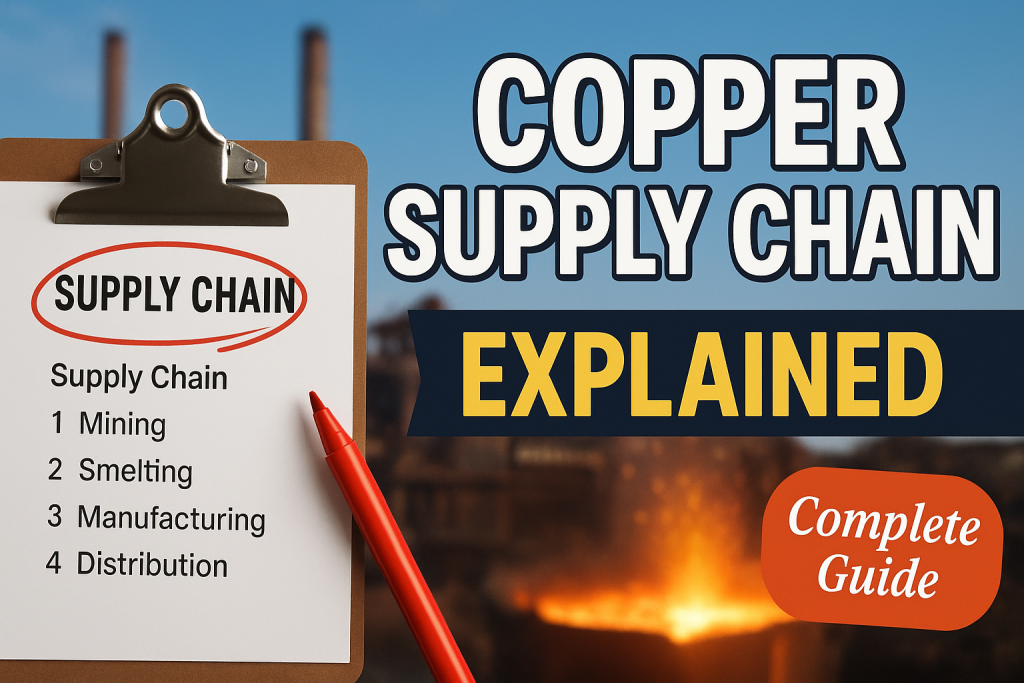
Copper supply chain defined The copper supply chain begins with ore extraction from open-pit or underground mines and ends with fabricated copper products — wire, pipe, sheet, and rod — used in construction, electronics, and energy infrastructure. The chain runs through crushing, concentration, smelting, and refining stages before producing copper cathode, the standard tradeable form. Chile, Peru, and the DRC mine the majority of the world’s copper. China dominates the processing stages.
Table of Contents
- Why the Copper Supply Chain Matters
- Stage 1: Mining and Ore Extraction
- Stage 2: Crushing and Concentration
- Stage 3: Smelting and Converting
- Stage 4: Refining and Cathode Production
- Stage 5: Fabrication into Finished Products
- Major Producing Countries and Their Roles
- China’s Dominance in the Middle of the Chain
- Energy Transition Demand: Why Copper Needs Are Growing
- Copper Recycling: The Secondary Supply Chain
- LME Copper: The Global Price Benchmark
- Frequently Asked Questions
- Key Takeaways
Why the Copper Supply Chain Matters
Copper is the world’s most important industrial metal after steel and aluminium. It conducts electricity better than any other affordable metal, which is why it sits inside every electric motor, every transformer, and almost every electronic device on Earth.
For a shipping or trade professional, copper moves in multiple forms across the supply chain. Copper concentrate ships in bulk carriers from South America to Asian smelters. Copper cathode — the refined, standard form — moves in containers. Copper scrap flows globally from industrial and post-consumer waste streams. Understanding where copper is in its supply chain tells you how it ships, who handles it, and what determines its price.
The copper price benchmark is set on the London Metal Exchange (LME). It affects every stage of the chain.
Stage 1: Mining and Ore Extraction
Copper is found in two main deposit types: porphyry deposits — large, low-grade ore bodies typically mined in open pits — and sediment-hosted deposits, which tend to be higher-grade and often mined underground.
The world’s largest copper mines are open-pit operations. Escondida in Chile’s Atacama Desert is the single largest copper mine in the world, producing around 1.2 million tonnes of copper per year. Collahuasi, also in Chile, produces another 600,000 tonnes annually.
Ore grades at major mines typically run between 0.3% and 1.5% copper. That means you need to move and process between 70 and 300 tonnes of rock to produce one tonne of copper. Mining is therefore energy-intensive and water-intensive — a major consideration in the water-scarce Atacama region.
Once ore is blasted and loaded, it goes by truck or conveyor to a crushing facility at or near the mine site.
Stage 2: Crushing and Concentration
Crushed ore is too low-grade to smelt directly. It must be concentrated first.
Concentration uses a process called froth flotation. Finely ground ore is mixed with water and chemical reagents. Air is pumped through the slurry. Copper-bearing minerals attach to air bubbles and float to the surface. The waste material — called gangue or tailings — sinks and is pumped to tailings storage facilities.
The output of concentration is copper concentrate, a powder or slurry that typically contains 25-35% copper, along with gold, silver, and other trace elements. This is far more economical to transport than raw ore.
Most copper concentrate produced in South America and Africa is shipped in bulk carriers to smelters, the majority of which are located in China, Japan, and South Korea. The concentrate is loaded at terminals like the port of Antofagasta in Chile or Lüderitz in Namibia.
Treatment and refining charges (TC/RCs) are the fees smelters charge miners to process concentrate. They are a critical commercial term negotiated annually between major miners and smelters, and they signal which party has more bargaining power in the market.
Stage 3: Smelting and Converting
At the smelter, copper concentrate is fed into a flash smelting furnace or similar high-temperature unit. The concentrate is heated to around 1,300°C. Sulphur burns off as sulphur dioxide (which modern smelters capture for sulphuric acid production). Iron and other impurities slag off. The molten copper-rich material — called matte — contains 50-75% copper.
The matte goes into a converter furnace where more impurities are removed, producing blister copper at around 98-99% purity.
Blister copper is still not pure enough for most electrical applications. It goes to the next stage: refining.
Stage 4: Refining and Cathode Production
Electrolytic refining is the final purification step. Blister copper is cast into thick slabs called anodes and placed in an electrolytic bath with a thin sheet of pure copper as the cathode. When electric current is applied, copper dissolves from the anode and deposits on the cathode with 99.99% purity. Impurities — including gold and silver — fall to the bottom as anode slimes, which are recovered and sold separately.
The end product is copper cathode — flat, rectangular sheets of 99.99% pure copper, each weighing around 125 kg. This is the standard tradeable form of refined copper.
LME-registered copper cathode must meet the LME Grade A specification: minimum 99.9935% copper, with tight limits on impurities. This standard is what makes copper cathode a globally fungible commodity — a tonne of cathode from a Chilean refinery and a tonne from a Japanese refinery are interchangeable.
Stage 5: Fabrication into Finished Products
Copper cathode is the starting point for fabrication. Rod mills melt cathode and cast it into copper rod — the most common intermediate form, produced in continuous coils. Rod is drawn into wire of various gauges for electrical applications.
Other fabrication routes produce:
- Copper pipe and tube for plumbing and refrigeration
- Copper sheet and strip for roofing, heat exchangers, and electronics
- Copper alloys — brass (copper + zinc) and bronze (copper + tin) for engineering components
The fabrication stage is highly disaggregated. Thousands of manufacturers worldwide process copper into finished products. The key buyers of copper cathode and rod are wire and cable manufacturers — companies like Prysmian, Nexans, and Sumitomo Electric — and tube manufacturers for the HVAC and construction industries.
Major Producing Countries and Their Roles
| Country | Share of Global Mine Output | Key Mines / Notes |
|---|---|---|
| Chile | ~27% | Escondida, Collahuasi, El Teniente |
| Peru | ~10% | Antamina, Cerro Verde, Las Bambas |
| DRC | ~10% | Kamoa-Kakula, Tenke Fungurume |
| China | ~9% | Domestic production; also world’s largest consumer |
| Russia | ~4% | Norilsk Nickel as main producer |
| Australia | ~4% | Olympic Dam (also uranium/gold) |
| USA | ~4% | Morenci, Bingham Canyon (Utah) |
Chile’s dominance is structural. The Atacama Desert hosts the world’s highest concentration of copper deposits. But Chilean production has been constrained in recent years by falling ore grades, water scarcity, and policy uncertainty around mining royalties and taxation.
The DRC is the fastest-growing major producer. Kamoa-Kakula, majority-owned by Ivanhoe Mines, began commercial production in 2021 and is ramping toward 500,000 tonnes per year — potentially making it the world’s second-largest copper mine.
Peru’s production has been disrupted repeatedly by community protests around mines, which has added to price volatility on the LME.
China’s Dominance in the Middle of the Chain
The simplest summary of global copper trade: Chile mines it, China processes it, the world buys it.
China accounts for roughly 40% of global copper consumption. It also dominates the smelting and refining stages. Chinese smelters process copper concentrate imported from South America, Africa, and Australia, then refine it to cathode for domestic fabrication or re-export.
This creates a specific trade pattern:
- Chile and Peru export copper concentrate in bulk carriers to Chinese ports (mainly Yangshan near Shanghai and ports in Shandong province).
- Chinese smelters process concentrate to cathode.
- Chinese fabricators turn cathode into wire, rod, and other semi-finished products.
- Those products are exported globally — including to Western countries that do not have their own fabrication capacity.
The implication for supply chain risk is significant. A disruption in China’s smelting capacity — whether from energy rationing, environmental shutdowns, or trade disputes — affects global copper supply chains far more than its share of mining output alone would suggest.
This concentration became visible in 2023 and 2024 when Chinese smelters faced a squeeze from falling TC/RC charges and threatened collective production cuts to push back on miners’ pricing power.
Energy Transition Demand: Why Copper Needs Are Growing
Copper is the metal of electrification. Every technology that involves generating, transmitting, storing, or using electricity requires copper — and the energy transition is the largest electrification event in human history.
The specific demand drivers:
Electric vehicles (EVs): An average EV contains around 83 kg of copper, roughly four times the copper content of a conventional internal combustion engine vehicle (~20 kg). Battery packs, motors, wiring harnesses, and charging infrastructure all require copper.
Solar panels: A utility-scale solar installation uses approximately 5.5 tonnes of copper per megawatt of generating capacity — in wiring, inverters, and racking systems.
Wind turbines: A single offshore wind turbine uses 8-15 tonnes of copper, depending on size. The cables connecting offshore farms to shore add further volume.
Grid upgrades: Expanding and modernising electricity transmission and distribution networks — essential for handling renewable generation — is a massive copper consumer. Grid investment is accelerating in the US (Inflation Reduction Act), Europe (REPowerEU), and China.
Data centres and AI infrastructure: Each large data centre uses thousands of tonnes of copper in power systems, cooling systems, and network cabling. The AI buildout is driving significant additional demand.
UNCTAD and Wood Mackenzie have projected that copper demand could surge by 40% or more by 2040 relative to current consumption levels. The challenge: mines take 10-20 years from discovery to production. The supply response to rising demand cannot come quickly.
Copper Recycling: The Secondary Supply Chain
Copper recycling is economically important and metallurgically elegant: copper retains its properties through infinite recycling cycles, losing none of its conductivity or ductility.
Secondary (recycled) copper accounts for approximately 20% of global copper supply. This comes from two streams:
- New scrap (process scrap): Generated during manufacturing — off-cuts, turnings, and offcuts from wire drawing, tube mills, and fabricators. This scrap is collected close to the point of generation and is typically high-grade.
- Old scrap (post-consumer scrap): Recovered from end-of-life products — demolished buildings, scrapped vehicles, discarded electronics, and power cables. This is lower-grade and requires more processing to remove contaminants.
High-grade scrap (copper wire scrap, for example) can be directly melted and re-fabricated. Lower-grade mixed scrap goes to secondary smelters for refining.
China is the world’s largest importer of copper scrap. The trade in copper scrap from developed countries (US, Europe, Japan) to Chinese secondary smelters is significant — though Chinese import standards tightened from 2019 onward under pollution control policies, redirecting some scrap flows to Southeast Asian processors.
Recycling copper requires roughly 85% less energy than primary production from ore. As environmental costs of primary mining increase and ESG pressures intensify, the economics of secondary copper are improving.
LME Copper: The Global Price Benchmark
The London Metal Exchange (LME) is the global pricing benchmark for copper. LME copper prices are quoted in US dollars per metric tonne for Grade A cathode — the 99.99% pure standard.
The LME copper contract is one of the most liquid commodity contracts in the world. Physical traders, miners, fabricators, and financial investors all use LME futures to hedge or take price exposure. The standard LME contract is for 25 tonnes of cathode, delivered to LME-registered warehouses worldwide (including Rotterdam, New Orleans, Johor Bahru, and Gwangyang).
Copper is also traded on:
- COMEX (CME Group, New York): the US copper contract, quoted in cents per pound. Primarily used by US domestic players.
- SHFE (Shanghai Futures Exchange): the Chinese domestic copper contract, quoted in yuan per tonne. A proxy for Chinese domestic supply/demand.
The three exchanges are linked by arbitrage. When the SHFE price diverges significantly from LME + import costs, copper flows physically between markets to close the gap.
LME copper hit an all-time high of $10,730/tonne in March 2022 (briefly, during the post-COVID supply crunch and commodity supercycle fears). It has typically traded in the $7,000-$10,000 range in recent years.
Frequently Asked Questions
What is the biggest risk in the copper supply chain?
Concentration risk at multiple points: Chile and Peru dominate mining; China dominates smelting and refining; and a handful of mines (Escondida, Collahuasi, Kamoa-Kakula) account for a large share of global output. A strike at Escondida — which has occurred several times — can visibly move the global copper price.
What is copper concentrate and how is it traded?
Copper concentrate is the output of the concentration stage at mine sites — a fine powder containing 25-35% copper. It is traded between miners and smelters under long-term offtake agreements. Commercial terms include the TC/RC (treatment and refining charge) that smelters receive, and payability rates for gold and silver credits. Most concentrate ships in bulk carriers.
Why does China buy so much copper?
China is the world’s largest consumer of copper because it has the world’s largest manufacturing sector (using copper in electronics and appliances), the largest construction sector (using copper pipe and wiring), and is aggressively building renewable energy infrastructure and EV charging networks. China’s copper demand is so large that it effectively sets the global demand baseline.
How does copper recycling work?
Copper scrap is sorted by grade, then either directly re-melted for high-grade applications or smelted and refined for lower-grade scrap. Copper’s infinite recyclability with no loss of quality makes secondary copper economically attractive whenever scrap prices are below primary cathode prices minus processing costs.
What does LME Grade A mean?
LME Grade A is the quality standard for copper traded on the London Metal Exchange. It specifies 99.9935% minimum copper purity with strict limits on 14 individual impurities. Copper cathode meeting this specification from any registered refinery is fungible — interchangeable with cathode from any other registered refinery.
How does an EV drive copper demand specifically?
An EV uses copper in its battery pack (cooling systems and busbars), traction motor (stator windings), high-voltage wiring harness, on-board charger, and the AC/DC charging infrastructure. Total copper per EV is around 83 kg versus 20 kg for a conventional car. Global EV sales reaching 20+ million units per year adds several hundred thousand tonnes of copper demand annually.
Key Takeaways
- The copper supply chain runs from ore extraction through crushing, concentration, smelting, electrolytic refining, and fabrication to finished copper products.
- Chile is the world’s largest copper miner at roughly 27% of global output; Peru and the DRC are second and third.
- China dominates the middle of the chain — it processes the majority of the world’s copper concentrate and accounts for around 40% of global consumption.
- Copper cathode (99.99% pure, LME Grade A) is the standard tradeable form; the LME copper price in USD/tonne is the global benchmark.
- Energy transition demand — EVs at ~83 kg each, solar, wind, grid upgrades, and data centres — is expected to drive a 40% surge in copper demand by 2040, with supply unable to keep pace.
- Secondary (recycled) copper provides roughly 20% of global supply and is infinitely recyclable without loss of quality.
- Copper moves in different forms at different supply chain stages: concentrate in bulk carriers from South America to Asian smelters; cathode in containers to fabricators worldwide.
- TC/RC charges negotiated between miners and smelters are a key commercial signal of where bargaining power sits in the supply chain.
Related Reading
To deepen your understanding of the topics covered in this article, explore these related guides: another base metal whose concentrate-to-refined pathway mirrors copper's, how copper fits within the broader classification of exchange-traded metals and the ferrous supply chain that consumes copper in alloys and electrical wiring.

Understanding Commodities is a free, neutral education site explaining how global commodity markets work — for importers, exporters, agribusinesses, and manufacturers. Every guide is written from the business perspective, not the trading floor. No broker. No agenda. No jargon.
Continue Reading
More guides from Understanding Commodities
Natural Gas Liquids (NGLs): What They Are, How They're Priced, and Why They Matter
Natural gas liquids (NGLs) explained: what ethane, propane, butane and pentane are, how they're priced at Mont Belvieu, and why...
Read article →
Electric Arc Furnace vs Blast Furnace: CO2 Emissions, Costs, and the Future of Steelmaking
Electric arc furnace vs blast furnace: CO2 emissions, cost comparison, steel grades each can produce, and how green hydrogen DRI...
Read article →
EU ETS Explained: How the Emissions Trading System Works
EU ETS explained: how Europe's carbon trading system works, EUA price history, EU ETS 2 for buildings and transport, CBAM,...
Read article →