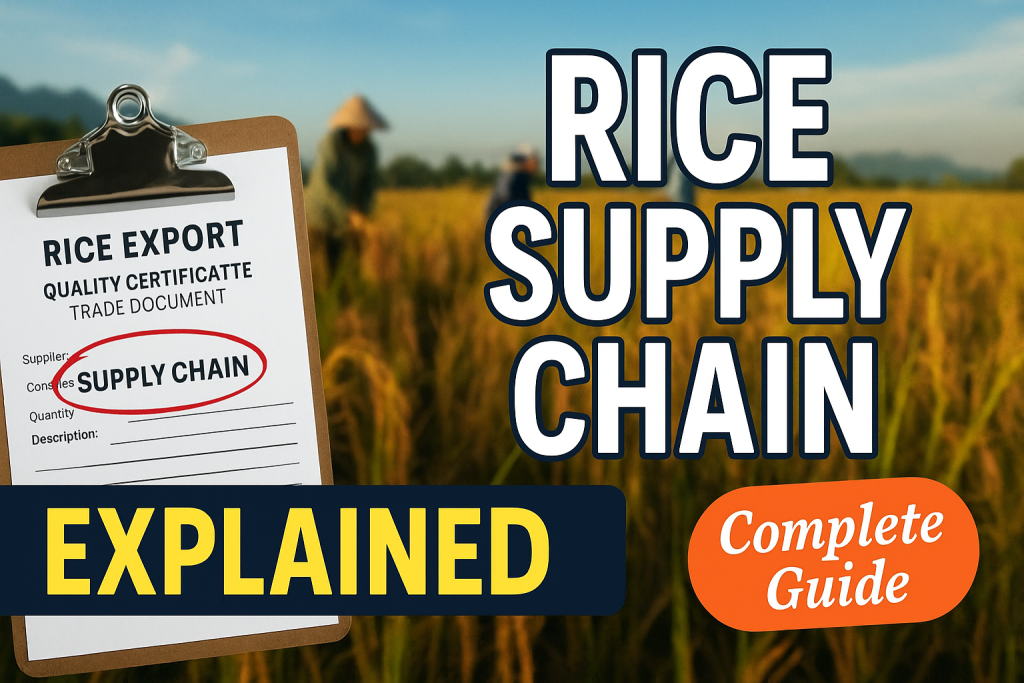
Rice supply chain defined The rice supply chain moves paddy rice (unmilled grain) from farms through milling, storage, and export infrastructure to consuming markets worldwide. Rice is the staple food for more than half the world’s population. The key export commodity form is milled white rice, traded by grade and broken percentage. Price benchmarks include Thai 5% broken and Vietnamese 5% broken for Asian export rice. CBOT rough rice futures (ticker ZR) provide a US market benchmark. India’s 2023 export ban — covering 40% of global rice trade volume — caused the largest rice price spike since 2008.
Table of Contents
- Why Rice Is Different from Other Grain Commodities
- Growing Regions and Top Producers
- The Supply Chain: Paddy to Plate
- Milling: Where Paddy Becomes Tradeable Rice
- Global Trade: Who Exports and Who Imports
- Commodity Pricing Benchmarks
- CBOT Rough Rice Futures (ZR)
- India’s 2023 Export Ban: The Defining Market Event
- Frequently Asked Questions
- Key Takeaways
Why Rice Is Different from Other Grain Commodities
Rice is the world’s most important staple food by calories for human consumption — more than wheat or corn. But it trades very differently from other major grains.
Most of the world’s rice is consumed domestically in the country where it is grown. Only about 8–10% of global rice production crosses international borders — compared to roughly 20–25% of global wheat and 15–20% of global corn. This “thin market” characteristic means that even relatively small disruptions to export supply have outsized price effects.
Rice also has dozens of distinct varieties — long grain, medium grain, short grain, jasmine, basmati, parboiled — with different consumer preferences across markets. Thai jasmine rice is not interchangeable with Indian basmati, which is not interchangeable with Japanese Koshihikari short-grain rice. These distinct markets resist full fungibility in a way that wheat (broadly divided into hard and soft, winter and spring) does not.
The combination of thin trade, political sensitivity (rice is a staple food with significant social stability implications), and varietal fragmentation makes rice one of the most policy-influenced commodity markets. Rice prices are heavily managed in major producing countries through floor prices, subsidies, and export restrictions.
Growing Regions and Top Producers
Rice is grown in tropical and subtropical climates where abundant water is available — either from monsoon rainfall, river irrigation, or elaborate irrigation systems.
China — the world’s largest rice producer (approximately 200–210 million tonnes of paddy per year) but consumes virtually all of it domestically. China is not a significant net exporter.
India — the world’s second-largest producer (approximately 130–145 million tonnes paddy) and, critically, the world’s largest rice exporter in most years, accounting for approximately 40% of global rice export volume. India’s Indus-Gangetic Plain, Andhra Pradesh, Tamil Nadu, and West Bengal are major producing regions. Indian exports include basmati (aromatic long-grain, primarily to Middle East and Western markets) and non-basmati (including parboiled rice to African markets and white rice to Asia).
Indonesia — third-largest producer (approximately 50–55 million tonnes), essentially all consumed domestically. Indonesia is periodically a significant rice importer despite its large production, due to population size.
Bangladesh — large producer, essentially self-sufficient, occasional importer.
Vietnam — major exporter (approximately 7–8 million tonnes per year). The Mekong Delta is Vietnam’s primary rice-producing region. Vietnamese rice dominates export markets in the Philippines, Malaysia, and parts of Africa.
Thailand — historically the world’s largest rice exporter, now typically second or third globally (approximately 8–9 million tonnes per year). Thailand exports high-quality jasmine rice (Hom Mali), parboiled, and white rice grades. The Thai 5% broken price is the world’s most important rice price benchmark.
Pakistan — significant exporter (approximately 4–6 million tonnes), specialising in basmati and long-grain rice. Pakistan’s 2022 floods severely damaged its rice crop, tightening supplies.
United States — relatively small producer (approximately 10–11 million tonnes paddy equivalent) but an important quality exporter, primarily of medium-grain and long-grain rice. California grows primarily short and medium grain; Arkansas and the Mississippi Delta grow long grain.
The Supply Chain: Paddy to Plate
The rice supply chain has six distinct stages from farm to consumer market.
Stage 1 — Growing
Rice is grown in flooded paddies in most Asian production systems — the standing water controls weeds and provides a stable environment for the semi-aquatic rice plant. In some systems (upland rice, aerobic rice), rice grows without flooding but with intensive irrigation.
A single growing cycle takes approximately 3–6 months depending on variety. Most major producing areas harvest 1–2 crops per year; Vietnam’s Mekong Delta can produce 3 crops with careful water management.
Stage 2 — Harvest (paddy rice)
Harvested rice is called paddy (or rough rice) — the grain still in its husk. Paddy must be dried to approximately 14% moisture content for safe storage. Improperly dried paddy spoils quickly and loses value. In large-scale commercial operations, mechanised combine harvesters cut and thresh the paddy simultaneously. In smallholder settings across much of Asia and Africa, harvesting remains partially manual.
Stage 3 — Drying and initial storage
Paddy is dried (in dryers or sun-dried on concrete pads) and then stored in silos, warehouses, or traditional sacks. Storage losses from insects, rodents, mould, and poor drying are a significant issue in many developing-country rice systems — estimated at 10–20% of total production in some contexts.
Stage 4 — Milling
This is the critical value-adding step (covered in more detail in the next section). Paddy passes through a rice mill to remove the husk (producing brown rice) and then the bran layers (producing white rice). Milled rice is the standard traded form.
Stage 5 — Export processing and shipment
Export-grade rice is cleaned, graded, and packed in 25 kg or 50 kg bags, or sometimes in 1-tonne bulk bags or in bulk (poured loose in container or vessel holds). Most Asian rice exports move in standard 20-foot containers packed with bagged rice. Some large volume trades (particularly parboiled rice from India to Africa) move as bulk cargo on handysize vessels.
Rice is loaded at major export ports: Bangkok (Thailand), Ho Chi Minh City and Da Nang (Vietnam), Kakinada and Kandla (India for non-basmati), Mundra (India for basmati), Karachi (Pakistan).
Stage 6 — Import and distribution
Importing countries receive rice at ports, clear customs, and distribute through wholesale and retail networks. In many importing countries, government agencies manage rice imports directly for food security reasons (Philippines’ National Food Authority, Malaysia’s BERNAS, parts of West Africa).
Milling: Where Paddy Becomes Tradeable Rice
Milling is the process that transforms rough paddy into the white milled rice that consumers recognise, and it is where the key quality grades are established.
Step 1: Husking (dehusking)
Paddy is passed through a husker that removes the outer husk (the inedible shell). The result is brown rice (also called cargo rice) — the whole grain with the bran layer intact. Brown rice retains more nutrition than white rice but has shorter shelf life because the bran layer oxidises.
Step 2: Whitening (milling / polishing)
Brown rice passes through whitening/polishing machines that abrade and remove the bran layers. The result is white rice — the standard form for most international trade. The degree of polishing determines the final appearance and nutritional content.
Degree of milling
“Well-milled” rice has had more bran removed — it looks whiter, has longer shelf life, and cooks consistently. “Undermilled” rice has some bran remaining — it has a slightly yellowish tinge and higher nutritional content but shorter shelf life. Export specifications typically specify degree of milling (usually “well-milled” or “double-milled”).
Step 3: Grading (broken percentage)
During milling, some grains break. The percentage of broken grains is the defining quality indicator in rice trade:
- 5% broken: mainly whole grains with up to 5% broken pieces. Premium quality, used in retail markets.
- 10% broken, 15% broken, 25% broken: intermediate grades, used in food service or mixed into higher-grade rice.
- 100% broken: broken rice (brewer’s rice, rice flour). Lowest value — used in food processing, animal feed, or rice flour production.
The Thai 5% broken and Vietnamese 5% broken prices are the global benchmark FOB export prices for standard-quality white rice.
Global Trade: Who Exports and Who Imports
Global rice trade runs at approximately 50–55 million tonnes of milled rice equivalent per year.
Top exporters (approximate annual volumes):
| Country | Volume (million t, approx.) | Key grades |
|---|---|---|
| India | 20–22 (pre-2023 ban) | Non-basmati white, parboiled, basmati |
| Thailand | 8–9 | 5% broken white, jasmine (Hom Mali), parboiled |
| Vietnam | 7–8 | 5% broken white, fragrant |
| Pakistan | 4–6 | Basmati, long-grain |
| United States | 3–4 | Long-grain, medium-grain |
| Myanmar | 2–3 | Long-grain white |
Top importers:
The Philippines is typically the world’s largest single rice importer (2–4 million tonnes per year) — a significant structural importer despite being a major Asian nation with significant rice production. Its population growth and arable land constraints make it persistently import-dependent.
China, despite being the world’s largest producer, periodically imports 2–5 million tonnes for quality reasons (Chinese consumers in specific regions prefer Thai jasmine or Vietnamese fragrant rice) and for strategic reserve purposes.
The EU (primarily Italy for arborio/risotto rice, other countries for consumer rice), Saudi Arabia, Iran, Iraq, Malaysia, and Senegal are all significant importers.
Sub-Saharan Africa has become a major and growing rice import market — Nigeria, Ivory Coast, Senegal, Ghana, and others imported increasing volumes through the 2010s and 2020s as urbanisation drove demand for convenient rice over traditional sorghum and millet staples.
Commodity Pricing Benchmarks
Rice does not have a single global exchange-based price in the way crude oil or copper does. It is priced through a system of benchmark FOB (Free On Board) prices at major export origins.
Thai 5% broken (white rice, FOB Bangkok)
The Thai 5% broken white rice price is the world’s most important rice price reference. It is published daily by the Thai Rice Exporters Association and widely referenced in trade contracts. It reflects the FOB export price at Bangkok for milled white rice with a maximum of 5% broken grains. It typically runs in the range of $400–600/tonne in normal markets, spiking significantly during supply disruptions.
Vietnamese 5% broken (white rice, FOB Ho Chi Minh City)
The Vietnamese 5% broken price is published by the Vietnam Food Association. Vietnamese rice trades at a discount or premium to Thai rice depending on quality differentials and supply conditions. In recent years, Vietnam’s fragrant and ST25 varieties have commanded premiums.
Indian parboiled 5% broken (FOB Kakinada or Krishnapatnam)
India publishes parboiled and raw white rice prices for its main export grades. Indian non-basmati parboiled rice has been a major supply source for West African markets and some Asian buyers. Basmati prices are tracked separately.
US No. 2 Long Grain Rough Rice
US rough rice is priced at Houston or New Orleans for export, typically on a CIF (cost insurance freight) or FOB basis. US long-grain rice from Arkansas grades are the reference for Central American and Caribbean buyers.
CBOT Rough Rice Futures (ZR)
The Chicago Board of Trade (CBOT) trades rough rice futures under the ticker ZR.
Contract specifications:
- Underlying: US No. 2 or better long-grain rough rice
- Contract size: 2,000 hundredweight (cwt) = approximately 91 metric tonnes
- Price quotation: US cents per hundredweight
- Delivery: approved warehouses in the US, primarily in Arkansas and other Southern US states
- Contract months: January, March, May, July, September, November
CBOT rough rice futures are less liquid than corn, wheat, or soybean futures — the US rice market is smaller and less globally significant than Asia-centric rice markets. However, ZR futures provide a useful financial hedging tool for US rice producers (Arkansas is the largest US rice state) and for market participants with exposure to US rice prices.
The CBOT rough rice contract reflects US domestic rice market conditions and does not directly price Thai or Vietnamese export rice. Correlation between CBOT rough rice and Asian benchmark prices exists but is imperfect — US rice competes in different market segments and is less subject to Asian government policy interventions.
For most international rice traders, the primary price references remain the Thai and Vietnamese export benchmark prices rather than CBOT ZR.
India’s 2023 Export Ban: The Defining Market Event
India’s July 2023 export ban on non-basmati white rice was the most consequential rice market event since the 2007-08 global food price crisis.
Background
India is the world’s largest rice exporter, with approximately 40% of global rice trade. Indian non-basmati white rice (the category targeted by the ban) is exported primarily to Africa, Asia, and the Middle East. Parboiled rice goes heavily to West African markets; white rice goes to buyers across the region.
In mid-2023, India was facing domestic rice price pressures. The El Niño weather pattern had reduced monsoon rainfall in key rice-growing states (Karnataka, Andhra Pradesh). With general elections approaching in early 2024, the Indian government was sensitive to domestic food price inflation.
The ban
On July 20, 2023, India’s government prohibited the export of non-basmati white rice, effective immediately. This covered approximately 25% of India’s rice export volume by value (non-basmati parboiled and broken rice remained unrestricted, but white rice was blocked).
In September 2023, India also imposed a 20% export duty on parboiled rice, significantly adding to the cost of what had been allowed. This effectively curtailed most non-basmati Indian rice exports.
Market impact
The price effects were immediate and sharp:
- Thai 5% broken white rice surged from approximately $540/tonne in July 2023 to approximately $650/tonne by late October 2023 — the highest level since 2008.
- Vietnamese 5% broken white rice similarly spiked.
- Philippines, a major India rice buyer, scrambled for alternative supplies from Thailand, Vietnam, and Pakistan.
- African importing countries (Nigeria, Ivory Coast, Senegal) faced immediate price increases.
The magnitude of the price spike illustrated the “thin market” characteristic of rice: with only 8–10% of global production traded internationally, removing a large exporter’s supply from the market — even temporarily — has disproportionate price effects.
Why this matters for logistics professionals
The India ban rerouted physical rice trade flows overnight. Buyers who had sourced from India had to urgently renegotiate contracts or secure supply from Thailand or Vietnam. Vietnamese and Thai export prices rose as their export capacity (limited by their own production volumes) was suddenly insufficient for increased demand. Freight markets for rice-carrying vessels on Asia-Africa routes tightened as purchasing scrambled to reroute.
India began partially lifting restrictions in 2024 as domestic supply conditions improved, but the episode reinforced how quickly government export policy can disrupt commodity trade flows — with freight market consequences measured in weeks.
Frequently Asked Questions
Why is rice traded in “broken” percentages?
Broken grains — those fractured during milling — have lower consumer appeal and slightly different cooking properties than whole grains. They are not defective in terms of food safety, but they command lower prices because consumers and food service buyers prefer the visual consistency and texture of whole-grain rice. The percentage of broken grains is therefore the primary quality grade indicator in rice trade, with 5% broken representing near-premium quality and 100% broken representing the lowest-grade milling byproduct.
What is parboiled rice and why does India export so much of it?
Parboiled rice is paddy that has been soaked, steamed under pressure, and dried before milling. The steam treatment gelatinises the starch and drives nutrients from the bran into the endosperm, making parboiled rice nutritionally superior to regular white rice and giving it a distinctive golden colour and firmer texture after cooking. Parboiled rice also has longer shelf life and is more resistant to insect damage than raw white rice — important advantages in humid tropical markets. India’s parboiled rice exports, primarily to West Africa, have grown substantially over the 2010s as African urban consumers adopted it for its cooking characteristics and value.
Is rice traded under long-term contracts or in the spot market?
Mostly spot or short-term contracts — 3 to 12 months. Unlike some commodities (LNG, iron ore) where multi-year supply contracts are common, rice trade is dominated by shorter-term transactions. Government-to-government deals (G2G) exist — for example, the Philippines’ National Food Authority historically negotiated G2G agreements with Vietnam — but commercial trade is primarily through private exporters and importers negotiating on a shipment-by-shipment or quarterly basis.
What is the difference between FOB and CIF pricing in rice?
FOB (Free On Board) price includes the cost of the rice and all handling until it is loaded on a vessel at the export port. The buyer pays freight and insurance. CIF (Cost Insurance Freight) includes freight and insurance to the destination port — the seller bears these costs and prices them in. Most rice benchmark prices (Thai 5% broken, Vietnamese 5% broken) are quoted FOB. African and Middle Eastern buyers often compare on a CIF basis to their destination port, adding freight rates to the FOB benchmark.
How does El Niño affect rice production and prices?
El Niño typically brings reduced monsoon rainfall to Southeast Asia and the Indian subcontinent — the primary rice-growing regions. Drier conditions reduce yields, particularly in rain-fed (non-irrigated) rice systems. The 2023 El Niño was a contributing factor in India’s decision to restrict exports, as domestic rice prices were rising due to monsoon disruption. Historical rice price spikes (including 2007-08 and 1998) have coincided with El Niño-related production shortfalls in major Asian producers.
Why don’t rice futures on CBOT see more trading volume?
US rice production (~10 million tonnes paddy) is a small fraction of world production (~500 million tonnes paddy). Most global rice pricing is done bilaterally between Asian exporters and importers, referencing Thai or Vietnamese benchmark prices rather than US futures. The CBOT rough rice contract also specifies US long-grain rough rice — a specific type not directly equivalent to the Thai or Vietnamese grades that dominate international trade. The result is limited hedging demand from international buyers, keeping ZR volumes modest relative to corn, soy, or wheat futures on the same exchange.
Key Takeaways
- Only 8–10% of global rice production crosses international borders — a thin market where supply disruptions have outsized price effects, unlike wheat or corn.
- The supply chain runs: growing → harvest (paddy) → drying → milling (husk removal, then bran removal to produce white rice) → export → distribution.
- The percentage of broken grains is the defining quality grade: 5% broken commands premium prices; 100% broken (fully broken rice) is the lowest-value grade.
- India is typically the world’s largest rice exporter at ~40% of global trade; Thailand and Vietnam are the next largest, with their 5% broken white rice prices as the dominant global benchmarks.
- The Thai 5% broken FOB Bangkok and Vietnamese 5% broken FOB Ho Chi Minh City prices are the primary global rice price references for international trade.
- CBOT rough rice futures (ZR, 2,000 cwt contracts) provide a US market benchmark but see limited volume compared to corn and soy, as most global rice pricing references Asian FOB benchmarks.
- India’s July 2023 ban on non-basmati white rice exports — affecting approximately 40% of global trade volume — caused the largest rice price spike since 2008, demonstrating the fragility of thin commodity markets to policy intervention.
- For logistics professionals, rice trade moves primarily in 20-foot containers with bagged cargo for Asian routes, and in bulk handysize vessels for high-volume Africa trades — and trade flows can reroute dramatically when export policy changes.
Related Reading
To deepen your understanding of the topics covered in this article, explore these related guides: the other major cereal staple that feeds global populations and the grain belt geographies that parallel rice-growing monsoon zones.

Understanding Commodities is a free, neutral education site explaining how global commodity markets work — for importers, exporters, agribusinesses, and manufacturers. Every guide is written from the business perspective, not the trading floor. No broker. No agenda. No jargon.
Continue Reading
More guides from Understanding Commodities

Lithium Carbonate Market Explained: Prices, Key Producers, and What Drives Global Demand
Lithium carbonate market explained: what Li2CO3 is, who produces it, how prices are set, and why EV demand cycles and...
Read article →
Natural Rubber vs Synthetic Rubber: Properties, Uses, Prices and How They Compare
Natural rubber vs synthetic rubber: properties, key uses, pricing, cost drivers, environmental comparison, and which rubber suits which application.
Read article →
Sweet Crude vs Sour Crude Oil: What's the Difference and Why Does It Matter?
Sweet crude vs sour crude oil: sulphur content explained, refining differences, IMO 2020 impact, global supply geography, and real-world benchmark...
Read article →