
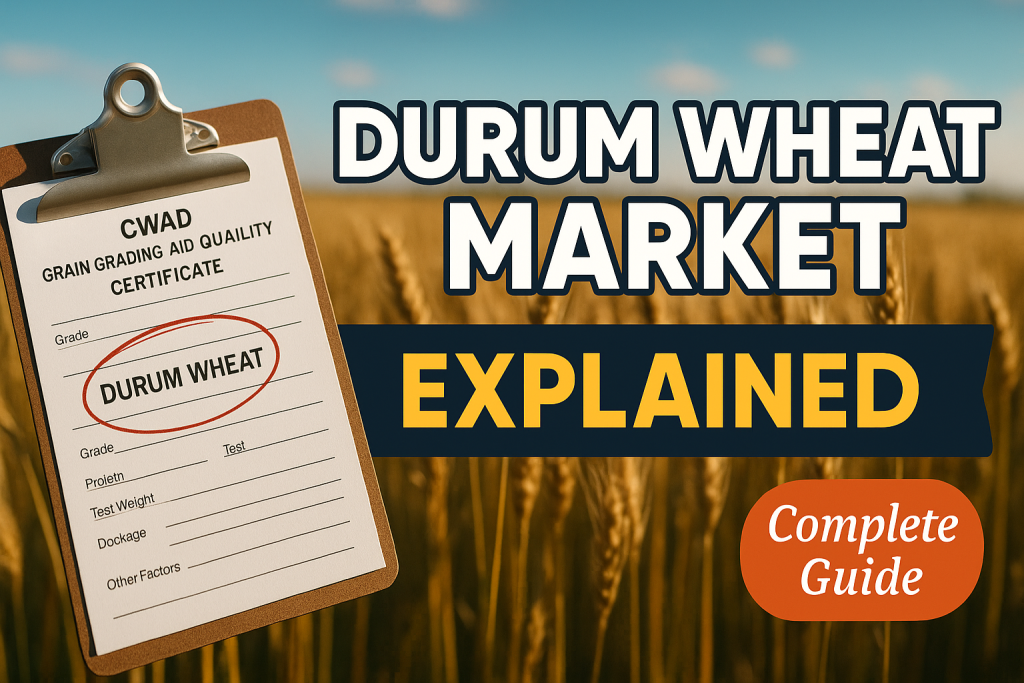
Durum wheat defined Durum wheat (Triticum durum) is a hard amber-coloured wheat species grown specifically for its high protein and strong gluten content, which makes it ideal for producing semolina — the coarse flour used in pasta, couscous, and some flatbreads. It has no practical commercial substitute in pasta production. Canada is the world’s largest durum exporter, and its CWAD (Canada Western Amber Durum) grade is the global quality benchmark. Durum prices are driven by Prairie weather, quality premiums, and the structure of Italian pasta manufacturing.
Table of Contents
- What Makes Durum Wheat Different
- Semolina: Why There Is No Substitute for Pasta
- Where Durum Is Grown: A Regional Guide
- Canada’s Dominant Role as World Exporter
- The Supply Chain: From Prairie Farm to Italian Mill
- Price Drivers: What Moves the Durum Market
- CWAD Grades and Quality Premiums
- Who Buys Durum: Italian Mills and North African Manufacturers
- Frequently Asked Questions
- Key Takeaways
What Makes Durum Wheat Different
Most of the wheat grown in the world is bread wheat (Triticum aestivum) — soft or hard red and white wheats milled into flour for bread, cakes, and biscuits. Durum is a separate species entirely.
The key difference is the gluten structure. Durum has very high protein content (12-15%) and a particularly strong, extensible gluten network. When durum semolina is mixed with water and extruded through pasta dies, that gluten network holds the pasta shape, survives boiling without disintegrating, and produces the firm “bite” (what Italian chefs call al dente) that characterises quality pasta.
Bread wheat flour cannot replicate this. It produces pasta that is soft, sticky, falls apart during cooking, and has poor texture. This is not a preference — it is a structural difference in the grain that cannot be replicated by any commercial wheat substitute.
Durum is also used in:
- Couscous — North Africa is the world’s largest per-capita consumer of couscous, making durum a staple grain for Morocco, Algeria, and Tunisia
- Bulgur wheat — a pre-cooked cracked durum product common in Middle Eastern and Turkish cuisine
- Semolina porridge and flatbreads — consumed in various forms across North Africa and the Middle East
Semolina: Why There Is No Substitute for Pasta
Semolina is the coarse, granular flour produced by milling durum wheat. Unlike bread flour (which is finely milled and soft), semolina has a distinct sandy, granular texture and a pale golden colour from its carotenoid content.
The milling process for durum is different from bread wheat milling. Durum endosperm is harder and more vitreous (glassy) than bread wheat. Semolina mills use a combination of break rolls and purifiers to crack the endosperm into semolina particles while keeping them separate from the bran. The result is semolina of 75-80% extraction — significantly coarser than bread flour.
Italian law (Legge 580/1967, later updated) requires that pasta sold in Italy must be made from 100% durum wheat semolina. This is not a quality standard or a preference — it is a legal requirement. The Italian pasta industry, which produces roughly 3 million tonnes of pasta per year, therefore has a structural need for durum semolina. That structural demand is what makes durum wheat prices distinct from, but correlated with, bread wheat prices.
Outside Italy, many countries allow pasta to be made from mixtures of durum and bread wheat flour, or entirely from bread wheat. But premium pasta produced for Italian and international quality markets typically specifies durum semolina regardless of local law.
Where Durum Is Grown: A Regional Guide
Durum is a warm-climate, drought-tolerant wheat that prefers drier growing conditions than bread wheat. It cannot be grown profitably everywhere.
Canada — Prairie Provinces (Saskatchewan, Alberta): Canada is consistently the world’s largest durum exporter and the global quality benchmark. Saskatchewan dominates Canadian durum production. The Canadian Prairies have an ideal dry continental climate for durum, producing high-protein, vitreous kernels with excellent colour. CWAD (Canada Western Amber Durum) is the standard the world measures against.
European Union — Italy, France, Greece, Spain: The EU is the world’s largest durum producer by volume, but most of its production is consumed domestically. Italy grows significant durum in the south (Puglia, Sicily, Basilicata) but still must import to meet its pasta industry’s needs. France (particularly the south and centre-west) and Greece (Thessaly region) are also producers. EU quality is variable — France and Italy can produce good durum in good years, but drought and quality problems are frequent.
North Africa — Morocco, Algeria, Tunisia: North Africa is simultaneously a significant producer and a massive importer. Morocco and Algeria grow durum domestically (used for couscous) but their rapidly growing populations have pushed imports to very high levels. Algeria is typically one of the world’s largest durum importers.
Turkey: Turkey grows significant durum and has a large domestic pasta and bulgur industry. In good years it may export modest volumes; in drought years it imports. Turkey’s dual role as producer/consumer makes its crop size a swing factor for nearby markets.
Kazakhstan: Kazakhstan produces durum in its northern steppe regions and has been an intermittent exporter, primarily to Turkey, Central Asia, and occasionally North Africa. Quality is variable.
Mexico and USA: The US produces durum in Montana, North Dakota, and Arizona. Mexico has domestic production used for pasta manufacturing. Neither is a major factor in global trade.
Canada’s Dominant Role as World Exporter
In a typical year, Canada exports between 3 and 5 million metric tonnes of durum — roughly 50-60% of total global durum trade. This dominance is built on three pillars.
Volume: The Canadian Prairies have vast acreage suited to durum. Saskatchewan alone can produce 4-6 million tonnes in a good year.
Quality: CWAD quality standards — set and enforced by the Canadian Grain Commission — are among the most reliable in the world. Buyers in Italy and North Africa trust CWAD grades because the system has decades of consistent enforcement behind it. Protein levels, vitreous kernel content (a measure of kernel hardness and quality), and falling number (a measure of enzyme damage) are routinely high in Canadian crops.
Export infrastructure: Canada’s Prairie grain moves by rail (primarily CN Rail and Canadian Pacific) to Thunder Bay (Lake Superior, for Great Lakes shipment) and Vancouver/Prince Rupert (Pacific ports, for Asian and cross-Pacific markets). For European and North African buyers, Thunder Bay exports via the St. Lawrence Seaway are common; Pacific ports serve Middle Eastern buyers through the Suez Canal.
When Canada’s Prairie crop is damaged by drought, excessive rain, or frost — all of which have occurred in recent years — the consequences for global durum prices are immediate and severe. The 2021 Canadian drought cut durum production by roughly 40% from the prior year, sending Canadian durum prices from approximately CAD $250/tonne to over CAD $600/tonne within months. Italian pasta manufacturers scrambled for alternative supplies from France and Mexico.
The Supply Chain: From Prairie Farm to Italian Mill
The journey from a Saskatchewan durum farm to an Italian pasta plate runs through a specific set of commercial steps.
Farm to grain elevator: Saskatchewan durum farmers deliver to primary elevators operated by companies like Viterra (now part of Glencore/Bunge), Richardson International, or the smaller Co-operative Elevate network. The elevator buys durum at a price based on quality (CWAD grade), moisture, and protein content — with premiums for higher protein.
Elevator to port: Durum moves by rail in covered hopper cars (CN or CP) from Prairie elevators to Thunder Bay, Vancouver, or Prince Rupert. This leg takes 3-7 days by rail.
Port export terminal to ocean vessel: At Thunder Bay, durum is loaded into vessels that navigate the St. Lawrence Seaway to the Atlantic. At Vancouver, it loads into handymax or panamax bulk carriers for Atlantic or Pacific routing.
Ocean voyage: Durum from Thunder Bay to Italian ports (Genoa, Livorno, Naples) sails through the St. Lawrence River and across the Atlantic — roughly 15-18 days. Durum from Vancouver bound for North Africa (Annaba, Algiers) or Turkey (Mersin, Istanbul) takes the Suez Canal route.
Semolina mill: Italian mills (the largest are Grandi Molini Italiani, Molini Spigadoro, Casillo Group) receive the grain at port, truck it to the mill, and produce semolina. The semolina is then sold to pasta manufacturers — large industrial producers like Barilla, De Cecco, and Divella.
Price negotiation: Italian mills typically buy forward — they contract for durum 2-6 months ahead to manage price exposure. The price is quoted in euros per tonne, CIF (cost, insurance, freight) Italian port, with a basis to the Canadian or US durum market.
Price Drivers: What Moves the Durum Market
Several factors systematically drive durum wheat prices up or down.
Canadian Prairie weather is the single most important factor. Saskatchewan weather during June and July — when durum crops are pollinating and filling grain — determines the size and quality of the world’s most important export crop. A dry June through August in Saskatchewan means a smaller crop with lower protein; a very wet summer means quality problems (sprouting, fusarium disease). Market participants monitor Saskatchewan crop condition reports weekly during this period.
The durum/soft wheat spread: Durum is almost always more expensive than comparable bread wheat because the supply base is smaller and the demand is less substitutable. The spread between Canadian durum and US Hard Red Winter (HRW) wheat prices varies considerably — in tight supply years the spread can exceed $100/tonne; in surplus years it narrows toward $30-40/tonne. Italian mills closely track this spread: when it widens dramatically, they may accept lower-quality durum or adjust pasta formulations for non-Italian markets.
Protein premiums: Within CWAD grades, high protein content (13%+) commands a significant premium because Italian mills need high protein for the gluten network in pasta. Low-protein durum discounts can be substantial. The protein distribution of a Canadian crop matters as much as its total volume.
North African politics and purchasing patterns: Algeria, Morocco, and Tunisia collectively buy millions of tonnes of durum per year. Algeria’s state purchasing agency (OAIC) is one of the largest single buyers in the world. How and when OAIC enters the market — typically with large tenders — moves prices significantly.
Competition from other exporters: When Canada’s crop is short, buyers turn to France, Mexico (primarily Sonora state), Kazakhstan, and Australia. These suppliers can partly fill the gap but generally at quality premiums or discounts that reflect their variable production standards.
CWAD Grades and Quality Premiums
Canada grades durum wheat through the Canadian Grain Commission under the CWAD (Canada Western Amber Durum) designation. Grades run from No. 1 CWAD (highest) to No. 4 CWAD, with distinct thresholds for:
- Vitreous kernels: The percentage of hard, amber, non-chalky kernels. High vitreous content (above 85%) indicates good quality; low vitreous (chalky kernels) reduces pasta colour and semolina yield. No. 1 CWAD requires a minimum of 75% vitreous.
- Falling number: A measure of alpha-amylase enzyme activity. Low falling number (below 300 seconds) indicates sprouting or weather damage and significantly reduces dough quality. Mills require a minimum falling number of 300+.
- Protein: Measured as a percentage of dry matter. Higher protein content (13-14%+) is prized by Italian mills and commands premiums of $5-15/tonne.
- Dockage and moisture: Standard grain cleanliness and moisture limits apply.
Commercial contracts typically specify a minimum grade (e.g., “No. 1 CWAD or better”), a minimum protein level, and a minimum falling number, with price adjustments for performance above or below these thresholds.
Who Buys Durum: Italian Mills and North African Manufacturers
Italy is the world’s largest pasta producer (approximately 3 million tonnes per year) and per-capita pasta consumer (around 23 kg/person/year). Italian semolina mills need approximately 4-5 million tonnes of durum per year, of which only 2-3 million is produced domestically. The rest is imported, primarily from Canada, with smaller quantities from France, Mexico, and occasionally Kazakhstan or Australia.
The major Italian mill groups — Casillo Group (Puglia), Grandi Molini Italiani, and Molini Spigadoro — are sophisticated buyers who negotiate forward contracts with Canadian exporters and closely track both the size and the quality of the Canadian crop.
Algeria is the world’s largest durum importer by volume — typically buying 3-4 million tonnes per year through OAIC (Office Algérien Interprofessionnel des Céréales). Algeria’s couscous consumption is among the highest per capita in the world. OAIC typically runs international tender processes, and the volumes it purchases in a single tender can be large enough to noticeably move world prices.
Morocco and Tunisia are also significant importers for couscous consumption. Both have growing populations and urban food sectors that are expanding couscous consumption.
Turkey is a large domestic producer but in drought years can become a significant importer, sometimes buying Canadian or French durum.
Frequently Asked Questions
Why can’t pasta be made from regular bread wheat?
Italian law requires pasta to be made from 100% durum wheat semolina. But the requirement is also technical: durum wheat has a unique gluten structure that holds pasta together during cooking, producing the firm al dente texture that defines quality pasta. Bread wheat flour produces soft, sticky pasta that breaks apart. No commercially viable substitute replicates the characteristics of durum semolina.
Why does Canadian weather have such a big effect on global durum prices?
Canada is the world’s largest durum exporter, typically supplying 50-60% of internationally traded durum. When Saskatchewan and Alberta have a drought — as in 2021 — the Canadian crop shrinks significantly. Because Canada dominates global supply, a Canadian production shortfall cannot easily be offset by other exporters, so prices spike sharply. The 2021 drought drove Canadian durum prices from around CAD $250/tonne to over CAD $600/tonne in a matter of months.
What is CWAD and why does it matter?
CWAD stands for Canada Western Amber Durum — the grading system applied by the Canadian Grain Commission to Canadian durum exports. CWAD grades (No. 1 through No. 4) specify thresholds for vitreous kernel content, protein, falling number, and cleanliness. The system’s credibility and consistency make CWAD the global quality benchmark; Italian mills and North African importers base their purchase specifications on CWAD standards.
What is the durum-soft wheat price spread?
The spread is the price difference between durum wheat and common bread wheat of comparable grade. Because durum has a unique end-use (pasta/couscous) with few alternatives, it typically commands a premium over bread wheat. The size of the premium varies with supply conditions — in years of Canadian drought it can exceed $100/tonne; in bumper crop years it narrows to $30-50/tonne. The spread is tracked closely by Italian pasta manufacturers and North African importers.
How does Algeria affect the global durum market?
Algeria is typically the world’s largest single durum importer, buying 3-4 million tonnes per year through state buyer OAIC. When OAIC issues a large international tender, it can move world prices because the volume required in a single purchase exceeds what any single origin can supply. The timing and specification of OAIC tenders are closely watched by durum traders.
Who are the main competitors to Canada in durum exports?
France (mainly Beauce and Languedoc regions) is the second most important exporter in good crop years. Mexico (Sonora state) exports to the US and some international buyers. Kazakhstan and Australia can provide supplementary supply. However, none of these can fully replace Canada in a year of Canadian crop failure — they lack Canada’s combination of volume, quality consistency, and export logistics.
Key Takeaways
- Durum wheat is a distinct species from bread wheat, with unique protein and gluten characteristics that make it irreplaceable in pasta and couscous production.
- Semolina — the coarse flour produced from durum — is legally required in Italian pasta and functionally irreplaceable for pasta quality worldwide.
- Canada (particularly Saskatchewan) is the world’s largest durum exporter, typically supplying 50-60% of internationally traded volumes; CWAD grades are the global quality benchmark.
- The Canadian Prairie crop in June-July is the single most watched supply variable in the global durum market — drought in Saskatchewan moves world prices immediately.
- Price drivers include Prairie weather, the durum-soft wheat spread, Canadian crop protein levels, and purchasing behaviour by Algeria’s state buyer OAIC.
- Italian semolina mills (Casillo, Grandi Molini Italiani, Molini Spigadoro) and North African importers are the dominant buyers, with Italy consuming around 4-5 million tonnes of durum per year.
- CWAD grading specifies vitreous kernel content, falling number, and protein — all of which affect price premiums and mill acceptability.
- Algeria is the world’s largest durum importer by volume, buying 3-4 million tonnes per year through OAIC tenders that can visibly move world prices.
Related Reading
To deepen your understanding of the topics covered in this article, explore these related guides: the broader market where all wheat classes trade, where durum sits on the protein and gluten spectrum and the arid Mediterranean zones where most durum is cultivated.

Understanding Commodities is a free, neutral education site explaining how global commodity markets work — for importers, exporters, agribusinesses, and manufacturers. Every guide is written from the business perspective, not the trading floor. No broker. No agenda. No jargon.
Continue Reading
More guides from Understanding Commodities
Cocoa Growing Regions: Where the World's Cocoa Comes From — and Why It Matters for Prices
Where cocoa is grown, why 70% comes from two West African countries, the 2023-24 price crisis above $10,000/tonne, ICE cocoa...
Read article →
The Rice Supply Chain Explained: From Paddy Field to Port to Plate
The rice supply chain explained: from paddy field through milling, storage and export to global markets. Covers price benchmarks, CBOT...
Read article →
What Is Warehouse Receipt Financing? How Stored Commodities Unlock Credit
What is warehouse receipt financing? How stored commodities become collateral for loans, LME warrants, CMAs, and the legal framework explained...
Read article →